

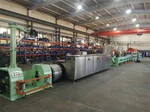
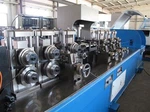
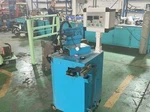
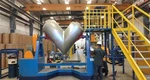
Welding Wire Winding Machinery
Comprehensive Technical Guide & Procurement Specification: Welding Wire Winding Machinery
Welding wire winding machinery is engineered to collect continuous welding wire onto coils, spools, or baskets in a tightly controlled, highly repeatable layer-winding pattern. By managing wire feeding, precise winding tension, traverse movement, and spool filling simultaneously, the machinery forms a uniform finished package designed for high-performance downstream applications.
For welding wire manufacturers, the quality of the winding process directly dictates downstream welding efficiency. A spool that is unevenly filled, loosely wound, or improperly traversed can cause severe feeding interruptions, birdnesting, increased scrap rates, and compromised weld quality.
Therefore, selecting the correct winding machine requires evaluating parameters far beyond wire diameter alone. Wire material characteristics, spool dimensions, target package weight, winding patterns, overall line speed, and the integration interface with upstream wire-drawing/surface-treatment lines and downstream packaging systems must all be carefully analyzed against international standards and capital expenditure (CapEx) metrics.
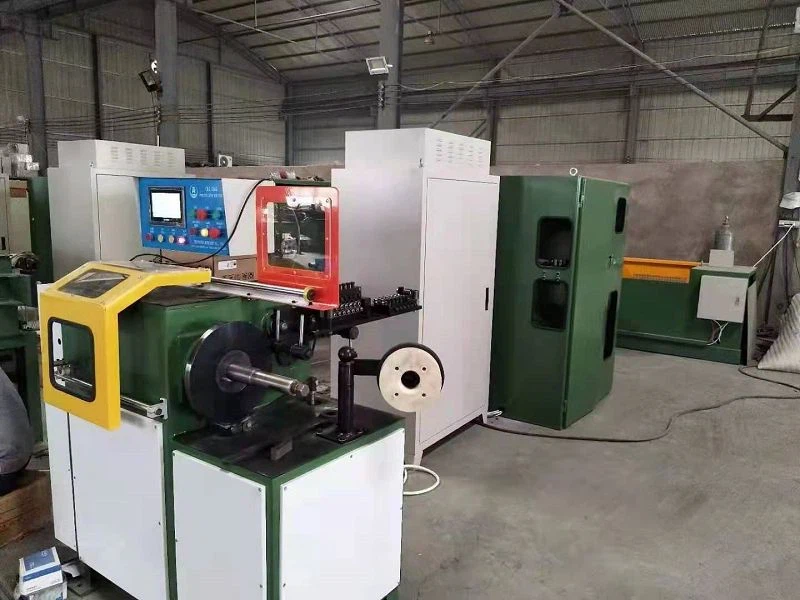

What Does a Welding Wire Winding Machine Do?
A welding wire winding machine takes continuous welding wire and spools it onto designated carriers with high geometric precision.
The core operational cycle typically encompasses:
Controlled Wire Feeding: Maintaining steady linear speed from the upstream process.
Tension Management: Applying precise, adjustable tension to prevent elongation or slackness.
Spool Rotation: Synchronized spindle or flyer rotation matching wire intake.
Traverse Movement: Precision servo-driven guiding mechanism for even layer distribution.
Package Filling: Monitoring volumetric or weight thresholds to prevent over-filling.
Automatic/Semi-Automatic Changeover: Cutting the wire and switching to a new spool with minimal downtime.
The objective extends far beyond simply transferring wire onto a spool. The system must maintain a rigid, synchronized relationship among wire feed speed, spool RPM, and traverse pitch to eliminate gaps and crossovers.
Engineering Selection: Working Backward From The Finished Package
To build an efficient production line, a suitable winding machine should always be selected from the finished wire package backward.
Define The Welding Wire Specifications
The baseline of any winding machine configuration is the wire itself:
Wire Type: Solid MIG/MAG, flux-cored, stainless steel, aluminum, or specialty alloys.
Diameter Range: Exact wire gauge or millimeters (e.g., 0.8 mm to 2.4 mm).
Tensile Strength & Stiffness: Dictates bending behavior and required tension control sensitivity.
Surface Condition: Clean, copper-coated, or lubricated surfaces affecting friction and grip.
Different alloys behave uniquely under tension. A machine optimized for mild steel MIG wire may require entirely different drive dynamics and contact materials for softer aluminum or brittle flux-cored wires.
Specify The Spool Or Coil Format
The final packaging geometry determines the mechanical design of the winding head and chuck:
Spool Standard & Dimensions: Compliance with international standards such as DIN 8559 and DIN EN ISO 544 for plastic spools (e.g., D200, D300), steel baskets, or metal drums.
Core & Flange Dimensions: Inner barrel diameter and outer flange width.
Maximum Package Weight: Capacities ranging from 5 kg precision spools up to 250 kg or 500 kg bulk drums.
Winding Geometry: Layer winding (precision helical) vs. random scatter winding (less common for high-end welding).

Winding Quality Supersedes Maximum Speed
In welding wire production, a high nominal speed is worthless if the resulting package exhibits structural defects. Poor winding quality triggers:
- Uneven spool filling and sidewall bulging
- Loose sections that allow wire to slip underneath lower layers
- Crossed or overlapping turns that wedge tightly during robotic welding
- Irregular wire payout resulting in arc instability or burnbacks
Achieving a stable, defect-free package requires harmonious synchronization between spool rotation, traverse pitch, and dynamic tension feedback. Plant managers should always evaluate machines based on winding consistency at operational speed, rather than peak catalogue velocity.
Application-Specific Considerations
MIG/MAG Welding Wire
Requires flawless layer winding to ensure smooth, uninterrupted feeding through contact tips during automated robotic welding.
Flux-Cored Welding Wire (FCAW)
Tubular construction demands gentle yet firm tension control to avoid crushing the outer sheath or disturbing internal flux powder.
Stainless Steel Wire
Demands high-purity contact surfaces (often ceramic or specialized coated guides) to prevent carbon contamination and corrosion.
Specialty & Aluminum Wire
Highly sensitive to scratching and elongation; requires ultra-precise low-tension control loops.
Automation Levels & ROI Impact: Manual vs. Semi-Automatic vs. Automatic
Capital expenditure (CapEx) decisions should factor in labor intensity and cycle repeatability against overall production volume:
Manual / Operator-Assisted: Ideal for low-volume production, frequent product changes, or specialized low-run alloys where human oversight is valuable.
Semi-Automatic: Automates the core winding and traverse process while utilizing operator assistance for loading empty spools and unloading finished packs.
Fully Automatic: Features automatic wire cutting, tail-securing, spool transfer, and empty spool loading. For high-volume plants, fully automatic changeover systems dramatically reduce machine downtime from minutes to mere seconds, directly boosting overall equipment effectiveness (OEE) and maximizing return on investment.
Essential Data for a Technical RFQ
To receive an accurate, engineering-backed proposal from machinery builders, global buyers should prepare an inquiry including the following parameters:
Wire type, material grade, and tensile strength
Wire diameter range (min to max)
Spool type, dimensions, and material conforming to international standards (e.g., DIN norms)
Target wire weight per spool / drum
Required winding speed or daily output targets
Desired automation level (Manual, Semi-Auto, Full-Auto) and expected changeover downtime targets
Existing upstream and downstream equipment interfaces
Available factory power supply, floor space limitations, and required safety compliance certifications (CE/ISO)
Frequently Asked Questions